Your Tribe Is Out There: How Grassroots SUP Clubs Are Reshaping Paddling Culture Across America
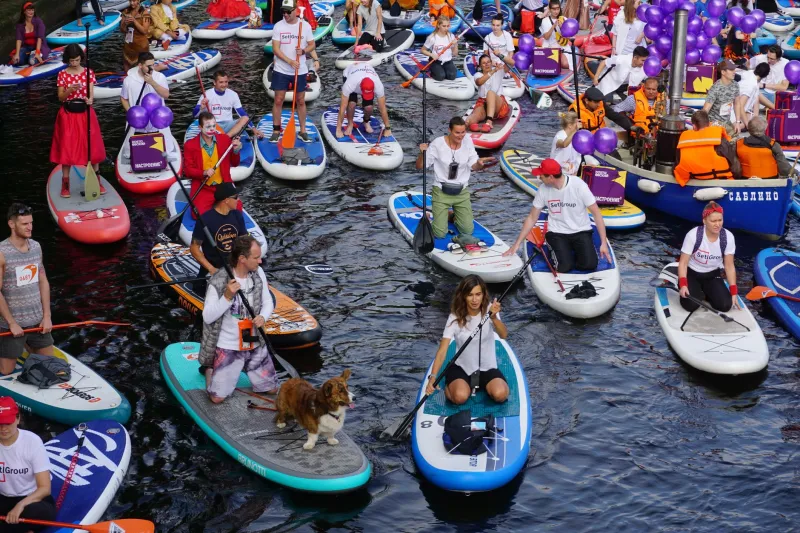
There's a version of stand-up paddleboarding that looks like this: you, a board, a quiet lake, and nobody else for miles. That version is real, and honestly, it's beautiful. But there's another version of SUP that doesn't get nearly enough airtime — one that involves a parking lot full of car racks, someone's homemade breakfast burritos, and a group text that somehow stays active year-round.
That version? It might actually be better.
Across the United States, a quiet revolution is happening at the water's edge. Local paddling clubs — some formal nonprofits, some barely more than a shared Google calendar — are pulling people off their couches, away from their screens, and into something that feels increasingly rare in modern life: genuine community.
More Than Just a Paddle
Ask anyone who's stumbled into a local SUP club and they'll tell you the same thing — they showed up for the workout and stayed for the people.
"I was brand new to paddling and honestly terrified to go out alone," says Marisol, a founding member of a women's paddling collective based in Austin, Texas. "I found this little club on Facebook, showed up to one Saturday morning session, and within a month these women were my closest friends. We paddle together, we travel together. It became this whole thing."
That "whole thing" is exactly what organizers across the country are intentionally building. The best clubs aren't just scheduling water time — they're creating infrastructure for connection. Group paddles, skill clinics, beach cleanups, post-paddle brunches, gear swaps. The water is the entry point, but the community is the product.
What Makes a SUP Club Actually Work
Not every paddling group finds its footing. Some fizzle out after a few months, victims of scheduling conflicts and the general chaos of adult life. So what separates the clubs that thrive from the ones that quietly ghost their own members?
Talk to enough organizers and a few themes keep surfacing.
Consistency over perfection. The clubs that last aren't necessarily the most organized — they're the most reliable. A standing Saturday morning paddle, rain or shine, gives people something to count on. "We've paddled in some truly ridiculous weather," laughs Derek, who co-founded a club on the Columbia River Gorge in Oregon. "But showing up every week, no matter what, is what built the trust. People know we're going to be there."
Radical welcome culture. The clubs with the strongest retention rates are almost obsessive about making newcomers feel included. That means no gear snobbery, no skill gatekeeping, and someone always willing to loan a board or walk a first-timer through their first wet exit. "We have a rule," says Priya, who runs a club on Lake Michigan outside Chicago. "If you see someone standing alone at the put-in, you go introduce yourself. Period."
A reason to stay off the water too. The clubs that build real friendships don't just paddle together — they do things. Potlucks, movie nights, volunteer days. One Colorado-based club throws an annual end-of-season bonfire that members plan for months. "By the time winter hits, we're already counting down to spring," says one longtime member. "That's how you know it's working."
Standout Clubs Worth Knowing About
While the SUP club scene is genuinely nationwide at this point, a few regional communities have become something of a blueprint for how to do this right.
The Gulf Coast Paddle Collective (Gulf Shores, Alabama) started as a small group of retirees and has grown into a multigenerational club with over 200 active members. They run weekly paddles, a junior paddler program for local kids, and an annual fundraiser that's raised tens of thousands of dollars for coastal conservation.
Bay Area SUP (San Francisco, California) has built a reputation for being one of the most inclusive urban paddling communities in the country. They partner with local adaptive sports organizations to ensure their programming is accessible to paddlers with physical disabilities — something that's become a core part of their identity.
Tennessee River Riders (Chattanooga, Tennessee) prove you don't need an ocean to build a serious paddling culture. They've turned a stretch of inland river into a legitimate SUP destination, hosting races, skill clinics, and even a beginner series that's introduced hundreds of Chattanoogans to the sport over the past four years.
How to Find — or Start — Your People
If you're reading this and feeling a little envious, good. That feeling is useful. Here's what to do with it.
Finding a club: Start with Meetup.com, Facebook Groups, and your local paddle shop — seriously, paddle shop employees know everything. Searching "[your city] SUP club" or "[your city] paddleboarding group" on social media will surface more options than you'd expect. The American Canoe Association also maintains a club directory that includes SUP-focused groups.
If nothing exists yet: Start something small. A group text. A standing Sunday paddle with three friends. Post in a local Facebook community group or neighborhood app and see who responds. You might be surprised. "I put up one post on Nextdoor saying I was looking for paddling partners," says Marcus, who now runs a 60-person club in Sarasota, Florida. "Within a week I had 15 people respond. People are out there looking for this."
What to bring to your first meetup: Your board (obviously), a genuine willingness to introduce yourself, and zero expectations about skill level. The best clubs will meet you exactly where you are.
The Bigger Picture
There's something quietly countercultural about what these clubs are doing. In an era of parasocial relationships and algorithmic content, a group of people who actually show up for each other — at the water's edge, in the cold, early on a Saturday — feels almost radical.
SUP has always had an adventurous soul. But the sport's most underrated feature might not be the full-body workout or the meditative quality of being on the water. It might be this: it gives strangers a reason to become friends.
Your tribe is out there. Go find them.