Why Paddling Might Be the Best Thing You Do for Your Brain This Year
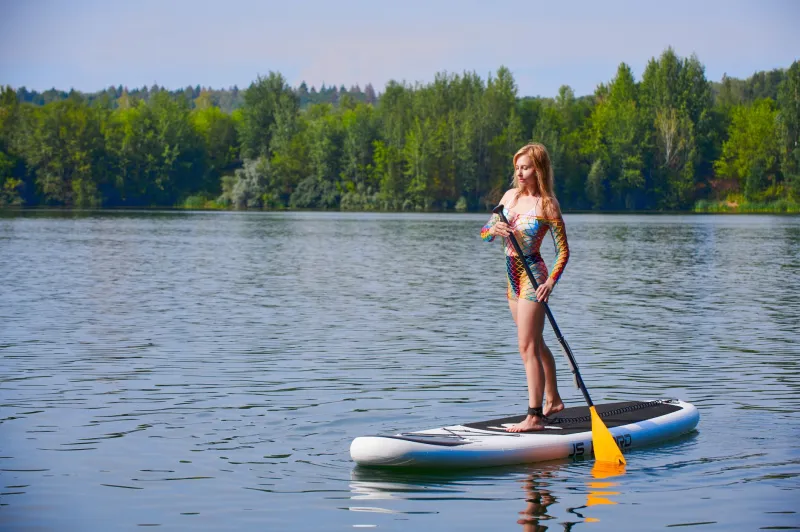
Let's be honest: everyone's got something they do to decompress. Running, yoga, hitting the gym, doom-scrolling until 1 a.m. — we all have our coping mechanisms. But there's a growing number of people who've landed on stand-up paddleboarding as something more than a hobby. For them, it's become something closer to therapy. The kind that actually works.
This isn't just vibes and anecdote. The overlap between what sports psychologists know about flow states, mindfulness, and stress regulation, and what SUP demands of your body and brain, is striking. And it's worth paying attention to.
The Anxiety Trap — And Why Most Fixes Miss
Anxiety in the US is at record levels. The American Psychological Association consistently reports that stress and anxiety are among the most common mental health challenges Americans face, with work, finances, and the relentless pace of modern life as the primary culprits. The standard prescriptions — exercise more, meditate, spend time in nature — aren't wrong, but they're often incomplete.
Here's the issue: most anxiety sufferers already know they should exercise. The problem is that traditional workouts don't always interrupt the mental loop. You can run five miles while your brain rehearses tomorrow's presentation on repeat. You can lift weights and still be somewhere else entirely. The activity isn't engaging enough to pull full attention away from the thought spiral.
SUP is different. And the reason comes down to one word: balance.
Balance as a Brain Hack
Standing on a paddleboard in open water requires constant, low-level neurological engagement. Your proprioceptive system — the network of sensors in your muscles and joints that tells your brain where your body is in space — is working overtime. Your core is making micro-adjustments dozens of times per minute. Your eyes are reading the water surface ahead of you.
You literally cannot think about your inbox.
Dr. Sarah Kimball, a sports psychologist based in Boulder, Colorado, describes this as "attentional capture" — when a physical task demands enough cognitive bandwidth that the brain's default mode network (the part responsible for rumination and self-referential thought) gets essentially crowded out. "Activities that require real-time physical problem-solving are uniquely effective at interrupting anxious thought patterns," she explains. "SUP hits that threshold for a lot of people in a way that running or cycling often doesn't, because the environment is constantly changing."
The water is never the same twice. Wind shifts, boat wakes, current — the board responds to all of it, and so must you. That dynamic unpredictability is actually a feature, not a bug, when it comes to mental engagement.
The Water Itself Matters
There's a reason people find the ocean, rivers, and lakes calming even when they're just watching from shore. "Blue mind" is the term marine biologist Wallace J. Nichols popularized to describe the mildly meditative state humans enter near water. Research suggests that proximity to water lowers cortisol levels, reduces heart rate, and shifts brain activity toward more relaxed, present-moment awareness.
Now put someone on the water — actively moving through it, reading it, responding to it — and you amplify that effect significantly. You're not just near the water. You're in conversation with it.
Long-time paddler and outdoor educator Tara Nguyen, who leads SUP wellness retreats in the Pacific Northwest, has watched this play out with hundreds of participants. "I've had people come out on the water completely locked up — shoulders tight, jaw clenched, barely present. Within twenty minutes, something shifts. It's not magic. It's the combination of movement, breath, water, and the fact that you genuinely have to pay attention to stay upright."
Progression and the Dopamine Factor
Anxiety and depression often share a common thread: the sense that nothing is moving forward, that effort doesn't produce results. SUP is a sport that delivers visible, tangible progress — and that matters more than it might seem.
Your first session, you're wobbly and probably fall in. Your tenth session, you're paddling confidently in a straight line. Your fiftieth, you're reading currents, adjusting your stroke, covering serious distance. Each increment of skill feels earned, and the brain rewards earned progress with dopamine — the neurotransmitter tied to motivation, pleasure, and a sense of accomplishment.
This progression curve is one reason SUP tends to build into a genuine habit rather than fading after a few weeks. Unlike some fitness pursuits where gains plateau quickly, paddling has depth. Flatwater technique, downwinding, SUP yoga, racing, river paddling — the rabbit hole goes deep, and there's always something new to chase.
"I started paddling because my therapist suggested I find something active that wasn't the gym," says Marcus Webb, a 34-year-old software developer from Austin, Texas. "Three years later, I'm doing downwind runs on Lady Bird Lake and planning a trip to paddle in the Columbia River Gorge. My anxiety hasn't disappeared, but my relationship with it is completely different. I have something that's mine."
Community as a Multiplier
One of the quieter mental health benefits of SUP is the community it tends to create. Paddling groups, local clubs, and informal morning sessions on the water build exactly the kind of low-pressure social connection that research consistently links to better mental health outcomes. You're not sitting across from someone at a dinner table trying to make conversation. You're moving together, watching the same sunrise, occasionally laughing when someone eats it on a boat wake.
That shared experience — physical, outdoor, slightly unpredictable — creates genuine bonds faster than most social settings allow.
Is SUP Right for Everyone?
Honestly? It's not a replacement for professional mental health support, and it shouldn't be framed that way. If you're dealing with serious depression or anxiety, please talk to someone qualified to help. But as a complement to treatment, or as a proactive practice for people managing everyday stress, the case for SUP is genuinely strong.
The barrier to entry is lower than most people think. You don't need to live near the ocean. You don't need to be an athlete. You need access to water — a lake, a reservoir, a calm river section — and enough curiosity to try something that asks your whole self to show up.
That might be the most underrated part of all this. SUP doesn't let you phone it in. And sometimes, not being able to phone it in is exactly what your brain needs.